Founder of the Georgian School of Morphology
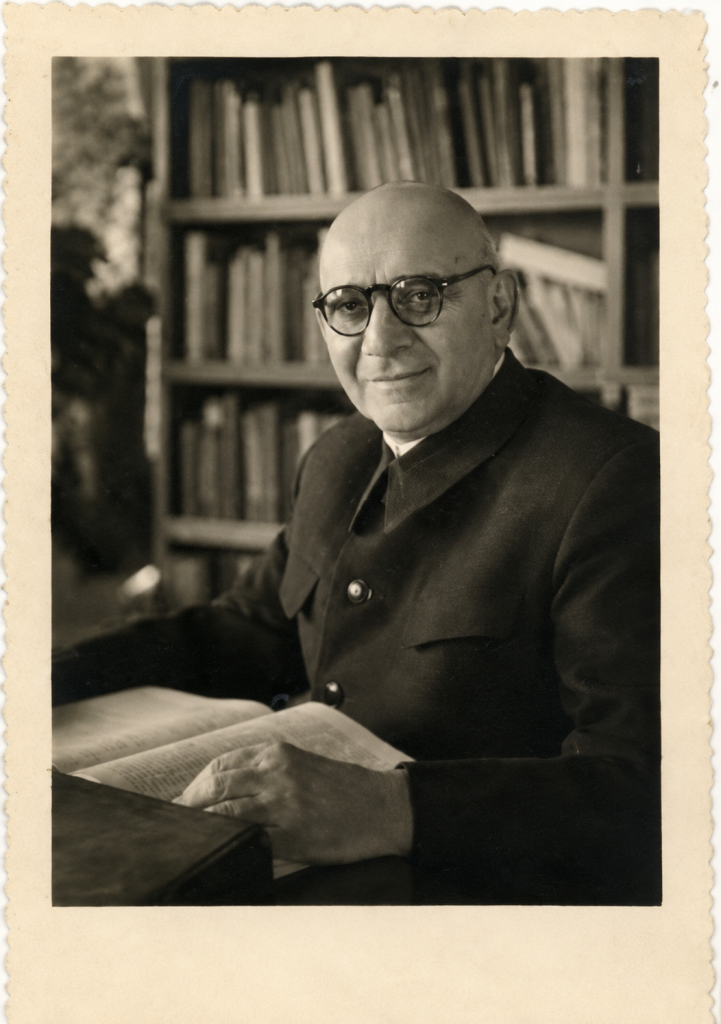
Academician Alexander Nikolozis dze Natishvili (1878–1959) was a Georgian anatomist, scientist, educator, and organizer of science, and one of the founders of scientific anatomy and anthropological research in Georgia. His name is associated with the creation of Georgian anatomical terminology, the publication of the first Georgian-language anatomy textbooks, the establishment of numerous scientific and educational fields, and the founding of the Institute of Experimental Morphology in 1946.
Education and the Beginning of His Scientific Career
Alexander Nikolozis dze Natishvili was born in Tbilisi on May 15, 1878. In 1899, he graduated from the Third Classical Gymnasium for Boys in Tbilisi and continued his studies at the Faculty of Medicine of Kharkiv University.
During his university studies, he developed a particular interest in normal human anatomy. After completing his studies, from 1907 he worked at the Department of Normal Human Anatomy of the Faculty of Medicine at Kharkiv University, initially as an assistant prosector. For his achievements in anatomical dissection, teaching activities, and scientific works, he was awarded the three-year Amalia and Wenzel Gruber Scholarship—first in 1908 and again in 1911.
From 1909 to 1911, Natishvili was engaged in teaching at the Kharkiv Institute of Obstetrics and Gynecology and at the feldsher school. He later worked as a senior assistant and prosector at the Department of Normal Human Anatomy of Kharkiv University. At the same time, he actively participated in the activities of scientific societies.
In 1917, he defended his doctoral dissertation on the topic “On the Morphology of the Cecum and Colon in Children Under One Year of Age” and was awarded the degree of Doctor of Medical Sciences.
Establishment of the Georgian School of Anatomy
In 1918, Alexander Natishvili returned to Georgia and began establishing and organizing the Department of Normal Human Anatomy at the newly founded Tbilisi State University. He was elected Head of the Department and remained in this position until the end of his life.
Of particular significance in the history of Georgian medical education is the fact that Alexander Natishvili delivered the first anatomy lecture in Georgian at Tbilisi State University. At that time, Georgian scientific anatomical terminology had not yet been established. According to a biographical source, on the evening before the first lecture, Ivane Javakhishvili and Alexander Natishvili worked together to create the Georgian terms needed for the lecture. The following day, the lecture was delivered in Georgian.
The development of Georgian anatomical language became one of the most important areas of Natishvili’s scientific and pedagogical work. In 1918–1919, Georgian terminology corresponding to the international anatomical nomenclature was gradually published for various anatomical systems, and later a complete Latin-Russian-Georgian anatomical terminology was developed.
Natishvili created the first Georgian textbook of normal human anatomy. Its first editions were initially published without illustrations, while later editions were extensively illustrated. From the fourth edition onward, more than 1,500 illustrations were added, with his wife, Evdokia Natishvili, and the artist Nino Zaalishvili contributing to their preparation. He also published a textbook on brain dissection and other specialized educational publications.
This work laid the foundation for the systematic teaching of anatomy in Georgian and made a significant contribution to the development of Georgian medical scientific language.
Teaching and Academic Activities
Alexander Natishvili’s activities were not limited to the Department of Anatomy. He actively participated in the organization of higher medical education in Georgia and in the establishment of new academic structures.
In 1919, he served as Dean of the Faculty of Medicine at Tbilisi State University, and from 1920 to 1922 as Vice-Rector of the University and Head of Academic Affairs. In 1930, following the separation of the Faculty of Medicine from TSU and the establishment of the Tbilisi State Medical Institute, he served as Deputy Director of the Institute, Head of Academic Affairs, and continued to lead the Department of Normal Human Anatomy.
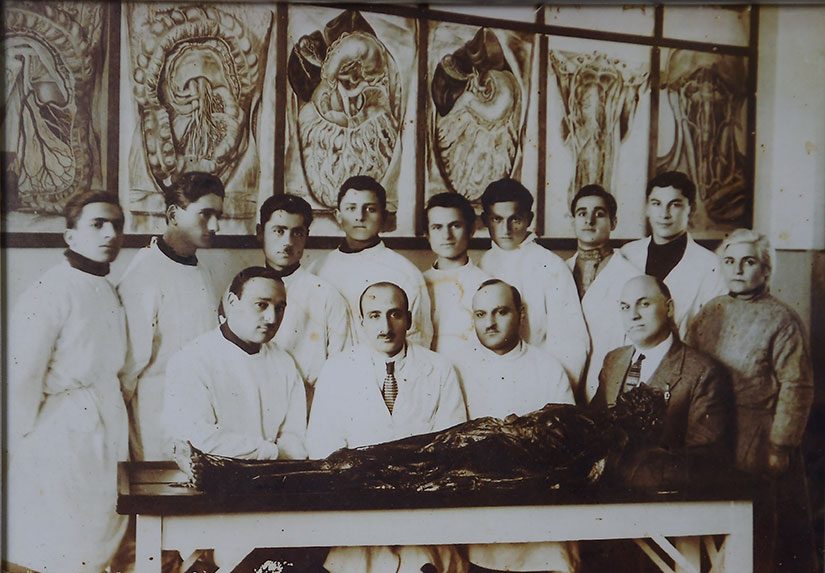
One of Natishvili’s significant achievements was the institutional development of various morphological disciplines. At different times, he participated in the establishment and development of departments of histology and embryology, topographic anatomy, plastic anatomy, and other fields. Leadership of the areas he organized was subsequently continued by his students and colleagues.
From 1924 to 1932, he worked at the Tbilisi State Academy of Arts, where he headed the Department of Plastic Anatomy and also created a textbook for this field. From 1932 to 1945, he worked at the Zooveterinary Institute, where he headed the Department of Anatomy of Animals and Birds. In 1935, he prepared a textbook on the anatomy of domestic animals and birds for students, using Latin-Georgian terminology, and established an anatomical museum.
His activities also encompassed secondary and postgraduate medical education. At various times, he supervised the training of medical personnel, and from 1943 to 1946, he served as Deputy Director and Head of Academic Affairs at the Tbilisi Institute for Advanced Medical Training.
Natishvili’s pedagogical legacy is not defined solely by the textbooks he created. He trained a generation of specialists who subsequently continued the development of anatomy and other morphological sciences in Georgia.
Development of Anthropology in Georgia
An important area of Alexander Natishvili’s scientific interests was the study of human physical development and anthropological characteristics.
From 1932 to 1941, he headed the Biometric Sector of the Institute for the Protection of Mothers and Children and the Anthropometric Office of the Psychoneurological Institute. Based on the study of data on the physical development of children and adolescents, he identified different periods of development, which had practical significance for clinical pediatrics. He also worked on standards for children’s furniture and other practical issues related to children’s physical development.
Of particular importance was the anthropological study of the population of Georgia. Based on research into ethnogenesis and the physical characteristics of the population, Natishvili identified five local anthropological variants of Georgia’s population — the Black Sea coastal, Western Georgian, Eastern Georgian, Southern Georgian, and Caucasian variants.
The research he initiated was subsequently expanded, and anthropology became one of the important scientific fields of the Institute of Morphology.
Natishvili often used illustrative examples during his lectures. To demonstrate changes in the physical development of adolescents, he once asked students to try on old chainmail garments — none of the students could fit into the clothing of their ancestors. Through this example, the scientist drew attention to differences in physical development between generations.
Establishment of the Institute of Experimental Morphology
One of the most important outcomes of Alexander Natishvili’s many years of scientific and organizational activity was the establishment of an independent morphological research center.
On April 1, 1946, on his initiative, the Institute of Experimental Morphology was established within the Academy of Sciences of the Georgian SSR. Alexander Natishvili was appointed the Institute’s first director and headed it until the end of his life.
The establishment of the Institute created a specialized scientific base where morphological research could be integrated with experimental medicine and new research areas could be developed.
Under Natishvili’s leadership, the foundations were laid for the Institute’s scientific school and its principal directions of further development. The Institute gradually became an important research center for morphological sciences, and a number of new scientific fields were subsequently developed on its basis.
Alexander Natishvili headed the Institute for 13 years — from 1946 to 1959. Following his death, the Institute of Experimental Morphology was named after him.
In 1946
Founded the Institute
13 Years
Served as the Institute’s First Director
In 1959
The Institute Was Named After Him
Organizer of Science and Public Figure
Alexander Natishvili was not only a scientist and educator, but also an active organizer of medical and biological sciences in Georgia.
In 1944, he was elected Academician of the Georgian Academy of Sciences. From 1947 to 1951, he headed the Academy’s Division of Biological and Medical Sciences and was a member of the Presidium of the Academy of Sciences. From 1951 to 1953, he also headed the Institute of Physiology of the Georgian Academy of Sciences.
Natishvili participated in the activities of professional scientific societies and in medical and morphological congresses and conferences. Following the establishment of the Tbilisi Society of Anatomy, Histology, and Embryology, he served continuously as its chairman.
An important feature of his organizational work was the creation of scientific infrastructure — the establishment of departments, museums, research fields, and institutes. He not only headed these structures himself but also trained scientists who would later develop them independently.
Alexander Natishvili’s activities extended beyond the medical field. He made a significant contribution to the restoration of the Abastumani resort and in 1924 served as director of the first tuberculosis sanatorium.
Recognition and Legacy
Alexander Natishvili’s many years of scientific, pedagogical, and public service were recognized with numerous state and academic honors.
In 1940, he was awarded the title of Honored Worker of Medical Science, and in 1944 he was elected Academician of the Georgian Academy of Sciences. He was awarded the Order of the Red Banner of Labour, the Order of the Badge of Honour, and two Orders of Lenin.
Alexander Natishvili died on May 3, 1959. He is buried at Vake Cemetery. To perpetuate his memory, the Institute of Experimental Morphology was named after Alexander Natishvili; a scholarship bearing his name was established at the Tbilisi State Medical Institute, and one of the streets in Tbilisi was named after him.
However, his principal legacy is much broader: the Georgian scientific language of anatomy, textbooks, the departments and scientific fields he established, the generations of researchers he trained, and the Institute of Experimental Morphology, which continues its scientific activities to this day.
Alexander Natishvili’s work laid an important foundation for the institutional and academic development of morphological sciences in Georgia.